


Hydroponic and Soil-Based Cultivation Systems: A Minireview
Sreehitha Padala
Department of Botany, St. Francis College for Women, Hyderabad, Telangana, 500016, India.
Saniya Vaishnav
Department of Botany, St. Francis College for Women, Hyderabad, Telangana, 500016, India.
Revathi Saravanan *
Department of Botany, St. Francis College for Women, Hyderabad, Telangana, 500016, India.
Basanti Chintapalli
Department of Botany, St. Francis College for Women, Hyderabad, Telangana, 500016, India.
*Author to whom correspondence should be addressed.
Abstract
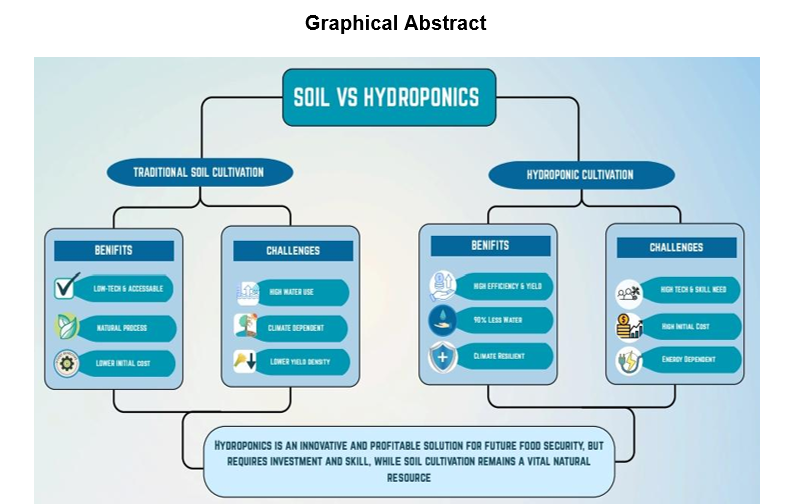
The world population is continuously growing. Using only conventional farming methods it is difficult to meet the production demands. Many regions in the world are suffering from hunger and harmful health hazards today. Increasing population, global warming, urbanization are a few major reasons, interconnected and tangled with each other. It is a difficult, but manageable problem now, which can soon turn into a serious crisis. It is required to either modify the current farming strategies, change the economic policies or adapt to new ways of growing food. While there are a bunch of solutions to apply, one effective way is trying modern Future Smart Farming techniques like Hydroponics. It is a soilless plant growing method, which sometimes involves using materials like coco peat, rock wool, perlite, etc; for mechanical support. It utilizes nutrient rich water, supplied directly to the plant roots using systems like NFT, DWC, etc. It is presently being used in countries like Japan, China; and has surprising outcomes. It is being studied by designated science institutions and is predicted to have a positive impact on the future by enhancing the living conditions in over populated, under-developed or developing countries. Currently it is important to spread awareness about hydroponics among the farmers and the common man. Our paper is a review article comparing the traditional - Soil Farming and the modern - Hydroponics Farming with various aspects, providing the reader insights of the two to understand the distinctness.
Keywords: Future smart farming, hydroponics, cost effectiveness, sustainability, Eco-friendly